Three A+++ Dryers, Only One With a Published Price
Three of the five heat-pump dryers we track earn the top legacy energy class. Their noise levels still span 59 to 66 decibels, and only one discloses a price.
By Nora Fischer · Last updated 26 July 2026
Researched and drafted with AI language-model assistance from CompareHomeAppliances' own verified spec database and cited public sources, per our AI-content disclosure.
Three of the five heat-pump tumble dryers in our database earn the top legacy energy class, A+++. Only one of the five publishes a price. Those two facts sit next to each other awkwardly: the category is honest and specific about efficiency, then goes almost silent on what the machine actually costs. If you are shopping heat-pump dryers this year, the label will tell you plenty about running cost and almost nothing about the checkout price.
Key takeaways:
- 3 of the 5 heat-pump dryers we track (Bosch Series 6 WQH246D9GB, LG FDV909W, Samsung DV90T5240AW) are rated A+++; AEG’s 8000 TR818P4B sits one tier lower at A++, and Miele’s T1 TWD 360 WP does not disclose an energy class at all.
- Among the three A+++ dryers, noise still spans 59 to 63 decibels, a 4-decibel gap between the quietest (Bosch) and loudest (Samsung) despite an identical top label.
- The AEG, the only A++ machine in the set, is also the loudest overall at 66 decibels, a pattern worth noting across 5 machines but not proof of a causal rule.
- Only 2 of the 5 dryers disclose a warranty at all: Bosch at 5 years, LG at 10, a 2x gap between the two brands that bother to state one.
- Only 1 of the 5, the Samsung DV90T5240AW at 547.00 EUR, publishes a price. The other four require a direct request to a retailer.
What do the five heat-pump dryers we track actually show?
All five machines in our current tumble-dryer set use heat-pump technology rather than older condenser or vented designs, so this comparison holds the drying method constant and lets the other fields do the talking. Capacity is tight across the group, 8 to 9 kilograms, so it is not the variable driving the differences below. Energy class, noise, warranty and price are.
| Model | Type | Energy class | Capacity (kg) | Noise (dB) | Warranty (yr) | Price (EUR) |
|---|---|---|---|---|---|---|
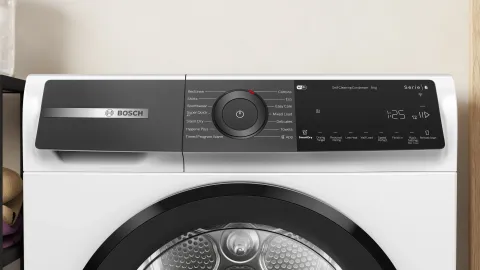
| Bosch Series 6 WQH246D9GB | Heat-pump | A+++ | 9 | 59 | 5 | N/A |
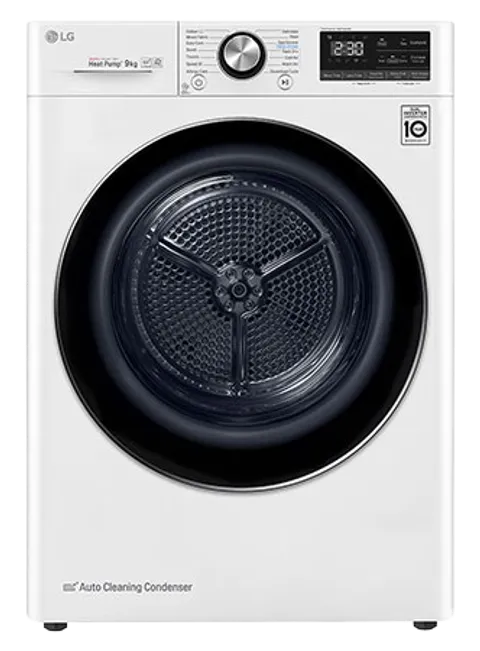
| LG FDV909W | Heat-pump | A+++ | 9 | 62 | 10 | N/A |
| Samsung DV90T5240AW | Heat-pump | A+++ | 9 | 63 | N/A | 547.00 |
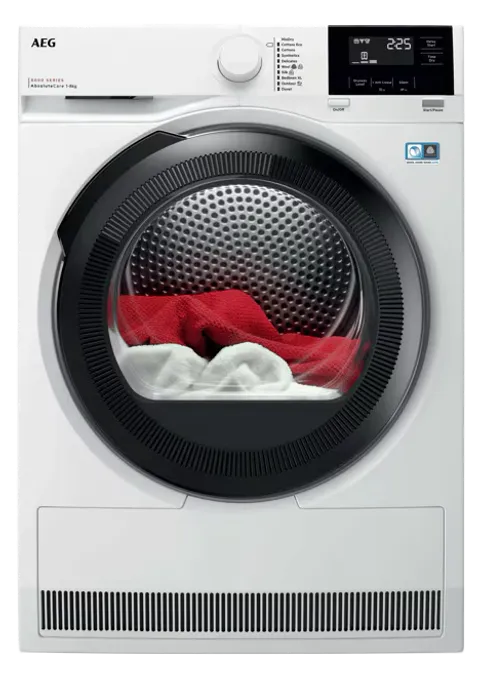
| AEG 8000 TR818P4B | Heat-pump | A++ | 8 | 66 | N/A | N/A |
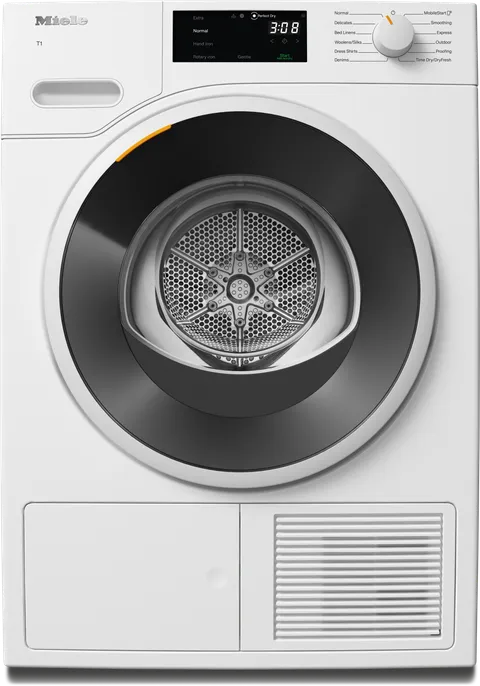
| Miele T1 TWD 360 WP 8kg | Heat-pump | N/A (not disclosed) | 8 | N/A | N/A | N/A |
Read across a row and the gaps in each column tell their own story. No single dryer in our set discloses all five fields at once. The Samsung is the only one with a price. The Bosch and LG are the only two with a stated warranty. The Miele does not disclose an energy class or a noise figure in our data at all, even though it is built on the same heat-pump principle as the rest.
Why are tumble dryers still rated on the old A+++ scale?
Correction, 2026-07-26: this section originally said tumble dryers had never been folded into the EU’s rescaling round. That was accurate when this piece was first published but is now out of date. Commission Delegated Regulation (EU) 2023/2534 rescaled the category onto a new A-to-G label, and since 1 July 2025 only that new scale may legally be shown in EU shops and online listings. Washing machines, refrigerators, dishwashers and televisions made the equivalent jump between 2019 and 2021.
At the time of writing, none of the five dryers in the table above had been individually re-checked against the new registry, so the A+++/A++ badges shown here reflect the legacy scale, not necessarily each model’s current legal label. We have since verified one of the five, the Bosch Series 6 WQH246D9GB, directly against the EU’s public EPREL registry: its own spec sheet still says A+++, its current registration says B. See the five-minute check before you pay for an ‘A+++’ dryer for that comparison and for how to check any model’s real current label yourself before paying extra for a badge. The other four dryers below have not yet been individually re-checked, which is a gap in our verification, not proof that their badges are wrong.
Does the same top energy label mean the same real-world dryer?
Not entirely, and the noise column in our table is the clearest example. The Bosch Series 6 WQH246D9GB, the LG FDV909W and the Samsung DV90T5240AW all carry the identical A+++ label, yet they run at 59, 62 and 63 decibels respectively. That is a 4-decibel spread inside one energy class, and decibels are a logarithmic scale, so the gap between the quietest and loudest A+++ machine here is genuinely audible in a laundry room next to a living space, not a rounding difference.
The AEG 8000 TR818P4B, the only dryer in the set rated one tier lower at A++, is also the loudest of all five at 66 decibels. That lines up with an intuitive story, that a less efficient heat pump and compressor cycle tends to run louder, but five data points is not enough to call it a proven rule. It is an observation worth flagging to a shopper, not a formula to build a purchase decision on by itself.
How much warranty information do dryer brands actually publish?
Very little, and what is published is inconsistent. Only 2 of the 5 heat-pump dryers in our database state a warranty figure at all. The Bosch Series 6 WQH246D9GB lists 5 years. The LG FDV909W lists 10 years, twice as long. Our data does not specify whether that LG figure covers the whole appliance or a single component such as the motor, so treat it as a plain 10-year headline number rather than assume it works the same way a motor-only warranty does on other appliance types. The Samsung, AEG and Miele dryers in this set disclose no warranty figure at all in our data.
A 2x gap between the two brands willing to publish a number, and three brands that publish none, is not enough information to rank these five machines on long-term backing. It is enough to tell a shopper that warranty length is worth asking about directly before buying, since the spec sheet alone will not answer it for three of the five options here.
Why is dryer pricing so hard to find?
Of the five heat-pump dryers we track, only the Samsung DV90T5240AW publishes a price, 547.00 EUR. The Bosch, LG, AEG and Miele models in our database show no manufacturer-listed price at all. That is a transparency gap specific to how this category discloses data, not a claim that those four dryers are unusually expensive, discontinued, or hard to buy. A shopper weighing any of them will need to request current pricing directly from a retailer rather than expect to find it published alongside the spec sheet.
This is worth remembering when a single published price sits next to four blanks: 547.00 EUR for the Samsung is a real, citable figure, but it should not be read as a stand-in for what the other four A+++ or A++ dryers in this set cost. Price is simply the thinnest field in the entire category right now.
The actual buying decision
If quiet operation matters more to you than a few extra years of stated warranty, the Bosch Series 6 WQH246D9GB’s 59 decibels is the standout in this set, still carrying the A+++ label and a published 5-year warranty. If a longer stated warranty matters more, the LG FDV909W’s 10 years is the longest figure any of the five discloses, at the cost of running 3 decibels louder than the Bosch. The AEG 8000 TR818P4B, one tier down at A++ and the loudest of the five, is worth a closer look only if its unpublished price turns out to be meaningfully lower once you ask a retailer directly.
Weighing two of these dryers side by side is easiest on our tumble dryers category page or head-to-head in the compare tool, where you can line up energy class, noise and capacity together. Given how thin the price data is across this category, plan to request a current quote directly from a retailer for any of the four models here that do not yet show one.
Appliances in this analysis
AEG
8000 AbsoluteCare TR818P4B
Bosch
Series 6 WQH246D9GB
LG
FDV909W (Dual Inverter HeatPump, Eco Hybrid)
Miele
T1 Heat-Pump Dryer TWD 360 WP 8kg
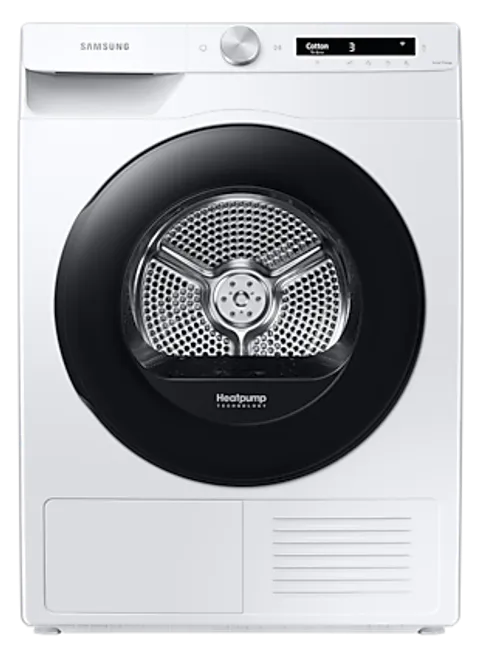
Samsung
DV90T5240AW/S2 (Series 5+ Optimal Dry)
Related categories
Frequently asked questions
Why are tumble dryers still rated on the old A+++ scale? +
Correction (2026-07-26): this answer originally said tumble dryers had never been rescaled and had no announced switch date. That is now known to be wrong. Commission Delegated Regulation (EU) 2023/2534 rescaled the category onto a new A-to-G label, mandatory in EU shops and online listings since 1 July 2025. The four dryers in this piece other than the Bosch still show the legacy A++/A+++ rating they had when this was written, unverified against the new registry. See our follow-up, the five-minute check before you pay for an 'A+++' dryer, for the full explanation, a live example of the same physical Bosch model rated A+++ on its own spec sheet and B on the current EU registry, and how to check any model yourself before paying extra for a badge.
Does an A+++ label mean two tumble dryers perform the same? +
No. Among the three A+++ heat-pump dryers in our database, noise ranges from 59 to 63 decibels, a real, audible 4-decibel spread, and warranty disclosure differs between them too. The top energy class tells you the machine is efficient; it does not tell you how loud it runs or how long the manufacturer stands behind it.
Why do so few tumble dryers publish a price? +
Only 1 of the 5 heat-pump dryers in our database lists a manufacturer price. That is a transparency gap in how this category publishes data, not a claim that the other four are expensive or unavailable; a shopper will usually need to request current pricing directly from a retailer.
Sources
- Commission Delegated Regulation (EU) No 392/2012 - energy labelling of household tumble driers (superseded from 1 Jul 2025, see correction above)
- Commission Regulation (EU) No 932/2012 - ecodesign requirements for household tumble driers (superseded from 1 Jul 2025, see correction above)
- European Commission - Tumble driers energy label and ecodesign
- European Commission - New measures for more energy efficient household tumble dryers from 1 July (Reg. 2023/2534, the current rescale)
More from the blog